Detailed Route Profiles
Legendary Climbs and Scenic Corridors
Every famous European route has a distinct personality. Some are brutal physical tests against gradient, while others offer gentle, car-free touring through centuries of cultural heritage.
1. Stelvio Pass (Passo dello Stelvio) — Italy
High Alpine Pass
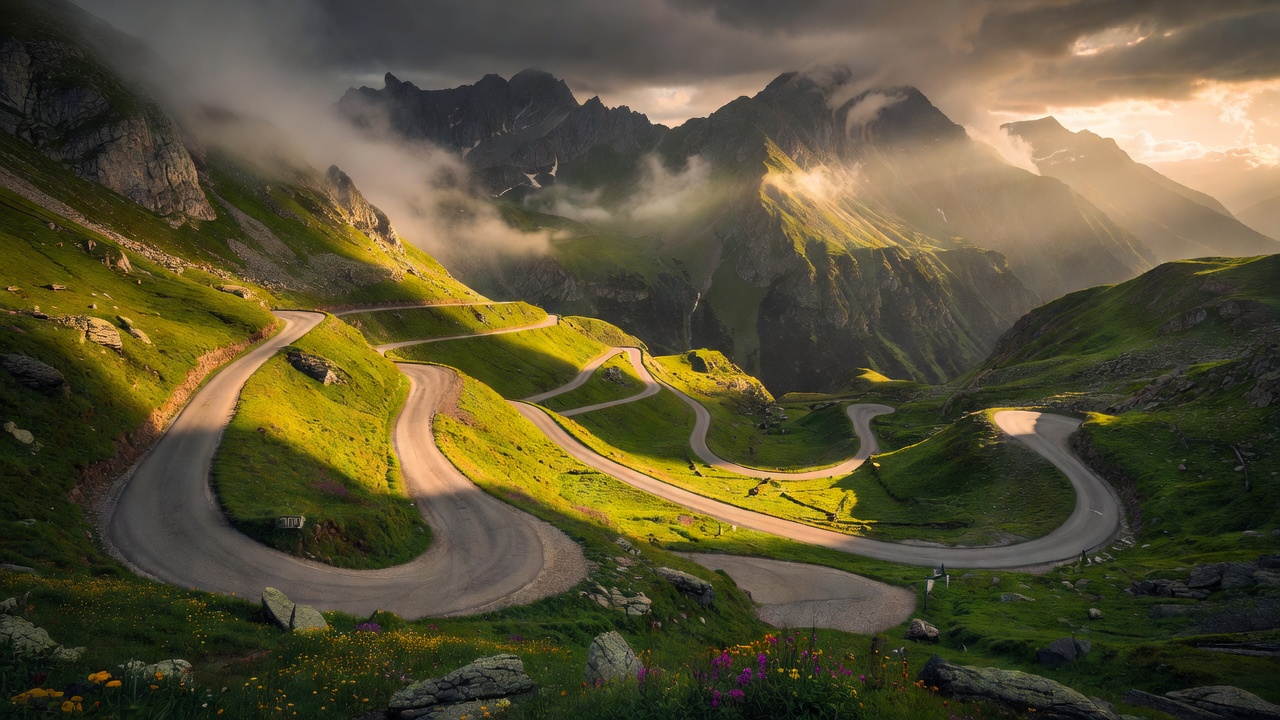
Route Character & Terrain: The Stelvio Pass is one of the highest paved mountain roads in the Eastern Alps. The classic ascent from Prato allo Stelvio features 48 numbered hairpin turns (known as tornanti) carved into the rock face. The gradient is steady, averaging between 7% and 8%, but the total climb spans almost 25 kilometers.
Scenery & Road Type: High mountain alpine road with pristine asphalt on the Italian side. You begin among alpine pine forests and finish above the tree line in a stark world of rock, scree, and glaciers near the summit at 2,757 meters.
Ideal Rider Profile: Well-conditioned road cyclists comfortable with sustained climbing for two to three hours without respite. Low gearing (such as a 34-tooth chainring with a 32 or 34-tooth rear cassette) is strongly recommended.
| Fact / Planning Item |
Verified Route Detail |
Planning Note |
| Summit Altitude |
2,757 m (verified geographical marker) |
Second highest paved pass in the Alps. |
| Climb Distance (from Prato) |
Approx. 24.8 km |
Allow 2.5 to 4 hours for ascent depending on fitness. |
| Average Gradient |
Approx. 7.4% (Max approx. 12%) |
Sustained effort; pacing in early kilometers is critical. |
| Best Riding Season |
Mid-June to late September |
Closed during winter and spring due to heavy snowfall. |
Pros of Riding Stelvio
Unmatched views of the Ortler massif, iconic switchback photography, and high-altitude cafes at the summit.
Challenges & Considerations
Motorbike and sports car traffic can be heavy on sunny summer weekends. Descent temperatures can plunge to near freezing even in July.
2. Alpe d'Huez (21 Hairpins) — French Alps
Tour de France Classic
Route Character & Terrain: Perhaps the most famous climb in professional cycling history. Starting outside the town of Le Bourg-d'Oisans, the road ascends through 21 numbered hairpins, each bearing the name of past Tour de France stage winners. The first two kilometers are unusually steep (exceeding 10% gradient) before settling into an 8% rhythm.
Ideal Rider Profile: Intermediate to advanced cyclists who want to test their power output against historical benchmarks. A wide range of amateur riders complete it every year during the summer season.
| Fact / Planning Item |
Verified Route Detail |
Planning Note |
| Climb Distance |
Approx. 13.8 km |
Short compared to passes like Galibier, but intense. |
| Elevation Gain |
Approx. 1,070 m |
Average gradient approx. 8.1%. |
| Best Season |
Late May to early October |
The south-facing slope can become extremely hot in July mid-days. |
Why Cyclists Love It
Rich cycling history, clear distance markers on every hairpin, and plenty of water fountains and bike shops at the summit resort.
Drawbacks
The climb ends at a modern ski resort rather than a pristine natural mountain pass.
3. Mont Ventoux (The Giant of Provence) — France
Limestone Moonscape
Route Character & Terrain: Standing alone above the rolling vineyards of Provence, Mont Ventoux can be climbed from three sides, with the ascent from Bédoin being the most legendary. The climb is 21.5 km long. The middle 9 kilometers through the forest average over 9% gradient with zero flat recovery sections.
The Final Lunar Sector: After passing Chalet Reynard, the trees abruptly vanish, replaced by stark white limestone scree and buffeting winds from the Mistral weather system. The weather observatory at the summit (1,912 m) serves as a dramatic beacon for the final six kilometers.
Key Highlights
Spectacular panoramic views across Provence and the Southern Alps; iconic cycling memorial to British rider Tom Simpson near the summit.
Weather Risks
Severe winds exceeding 80 km/h can close the upper summit road. Carry a windproof jacket even if the valley is 30°C.
4. Sa Calobra (Coll dels Reis) — Mallorca, Spain
Coastal Engineering Marvel
Route Character & Terrain: Unlike traditional mountain passes that you climb and descend, Sa Calobra requires you to descend down to the Mediterranean sea cove first, then climb out. The 9.5 km ascent features 26 turns and a famous 270-degree loop-the-loop bridge called Nus de Sa Corbata (Tie Knot).
Surface & Scenery: Silky smooth tarmac overlooking turquoise coves and rocky limestone cliffs. It is widely considered one of the finest engineered cycling roads in Europe.
Best Season: February to May and October to November. The island is warm while continental Europe is still cold.
5. Sella Ronda Circuit — Italian Dolomites
UNESCO World Heritage Loop
Route Character & Terrain: A circular 53-kilometer loop linking four high passes: Passo Gardena, Passo Sella, Passo Pordoi, and Passo Campolongo around the towering Sella rock massif. The loop totals around 1,650 meters of climbing without a single boring stretch of road.
Sella Ronda Bike Days: Twice a year (early summer and autumn), local authorities close all four passes to motorized vehicles, creating a safe, festival-like cycling celebration open to all amateur riders.
6. Danube Cycle Path (EuroVelo 6) — Austria & Germany
Riverside Touring
Route Character & Terrain: For cyclists seeking scenery without punishing mountain gradients, the Danube path between Passau (Germany) and Vienna (Austria) offers roughly 320 km of gentle, downhill-trending, paved cyclepaths along the riverbanks.
Ideal Rider Profile: Touring cyclists, families, e-bike riders, and bikepackers. The trail passes through the Wachau wine valley, medieval castles, and abbeys with frequent rail stations along the route.